
Electromechanical Swing
Clamp Unit
ESS
- For medium and larger presses
- For clamping upper dies
- For dies or adapter plates with identical dimensions and U-recesses
- Stationary installation on the slide edge
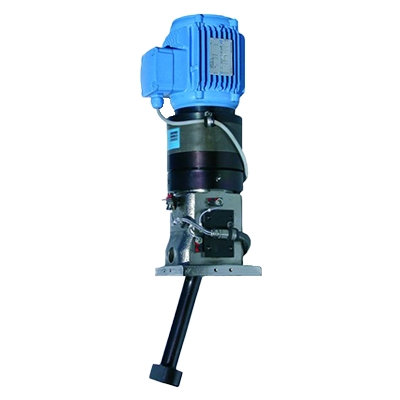
Mode of operation
- An electric motor with gear drive provides the clamping force.
- The swing movement is carried out by means of a mechanical guide.
Description
By means of a gear drive an electric motor causes a nut to rotate. Through this a tie bolt and a tie rod attached to it are moved up and down. The swing movement is effected by restricted guidance. When the unit is unclamped and the tie rod swung out the clamping area is completely free. Energy is only required during the process of clamping and unclamping. The clamp unit is mechanically self-locking. The clamping force is monitoring continuously.
- Mechanically self-locking
- Electric monitoring of all functions
- Fully automated operation
- Large clamping dimension tolerance
- Continuous clamping force monitoring
- Limit switches / cables
- Plug connectors
Technical data
| Type | ESS 60 | ESS 120 | ESS 240 |
|---|---|---|---|
| Clamping force [kN] | 60 | 120 | 240 |
| max. loading force [kN] 1) | 100 | 200 | 400 |
| Clamping dimension tolerance [mm] | +/- 7 | ||
| Stroke [mm] | 17 | ||
| Clamping speed [mm/s] | 2,2 | ||
| Motor: Type Supply voltage |
three-phase 400 V 50 HZ |
||
| Motorleistung [kW] | 0,55 | 0,75 | 1,5 |
| Limit switches: Number / type Supply voltage Connection type Designation |
• Four inductive proximity switches • PNP normally open; 10-30 V DC • Plug-in type (M8x1) • Tie rod swung in S4 • Tie rod swung out S5 • Continuous clamping force monitoring S6 • Maximum upper tie rod position S7 (clamped without die) |
||
| max. operating temperature [°C] | 70 | ||
| Weight [kg] | 40 | 43 | 48 |
1) Mechanical damage may occur at higher loads. Fixing is achieved with four screws M12, DIN 912 strength class 8.8 (not included).